Market intelligence:
The U.S. tariff divide


Keith D Wright, PhD, is Director of Business Diversity for the Port Authority of New York and New Jersey (PANYNJ). The Port Authority’s capital plan provides around $37b in capital investment to fund more than 600 projects.
Each year, the Port Authority relies on hundreds of minority-, women-owned, small, and disadvantaged business enterprises (MWSDBEs), as well as service-disabled veteran-owned small businesses (SDVOBs), to help deliver its services and projects. Here, Keith explains the thinking behind PANYNJ’s diversity programs.
A. I focus on the external business community and our engagement with them, working to provide opportunities for MWSDBEs and SDVOBs to showcase their skill sets and be part of the major work underway at our 26 facilities across the region.
After certification, our compliance unit ensures their viability and fitness for purpose, before—through capacity building—introducing them to our processes and helping them grow. This is my focus and my passion, and I’m surrounded by a great team.
A. We want the people working on our projects and services to reflect the demographics of those living and working in the communities where those projects and services take place.
We must ensure there is no exclusion of anyone who is ready, willing, and able to work—inclusivity means bringing the whole community to the table on our projects and services, giving them the opportunity to participate.
A. I’m a bit biased about this example, but it is an important one.
One thing we heard from the industry in 2018 was that there was a great deal of focus going into developing diversity, equity, and inclusion (DE&I) in relation to construction, but very little going into architecture and engineering.
So, we created training programs that targeted owners of MWSDBE architecture, engineering, and construction management companies.
From that initiative, a well-established cohort grew, which today is made up of around 60 firms. We have helped them scale, familiarized them with our systems, and supported them with marketing and HR. As a bonus, one cohort created an organization called the Council of Black Architects and Engineers. I believe this is a direct outcome of the work we started.
A. One thing my former teacher, diversity officer, and mentor, Michael Massiah—who had an illustrious career at the Port Authority—said before he left was: “Make sure the changes we were making were codified.”
We therefore created an executive manual that was signed off by our Executive Director. This included all the policies and procedures from a DE&I perspective to share across the organization.
In 2018, our Board of Commissioners agreed that, for all procurements, there would be a goal of 30% MWSDBE participation. Other interventions included developing unconscious bias training, and we changed our request for proposal (RFP) language so that it incorporated all firms—not just construction companies.
Now, contractors must achieve 30% MWSDBEs across each project, including design, operations, and maintenance.
A. Once known as “affinity groups” when they started 20 years ago, their purpose was to bring MWSDBE employees together in the company, to give them a level of comfort and speak with a louder voice. They evolved into an important resource—aligning communities with our business.
I would encourage businesses to put real focus into these kinds of groups. We have nine different resource groups now, which we manage and fund.
A. One challenge is defining the narrative we are presenting, internally and externally. You have the MWSDBE community looking for opportunity, but they are not getting opportunities commensurate with their numbers. Then you have some prime contractors that hide behind capacity.
They say that the MWSDBE firms can't do what they do, which is true. MWSDBE companies may not be able to take on $10b or $20b contracts like the primes can, but they can take on $10m or $25m opportunities.
So the question becomes: how do you bring the two sides together? Opportunity builds capacity. Big companies didn’t get big overnight—somebody helped them grow. So it really is about the narrative. When we say we want to be inclusive, we must be intentional about it.
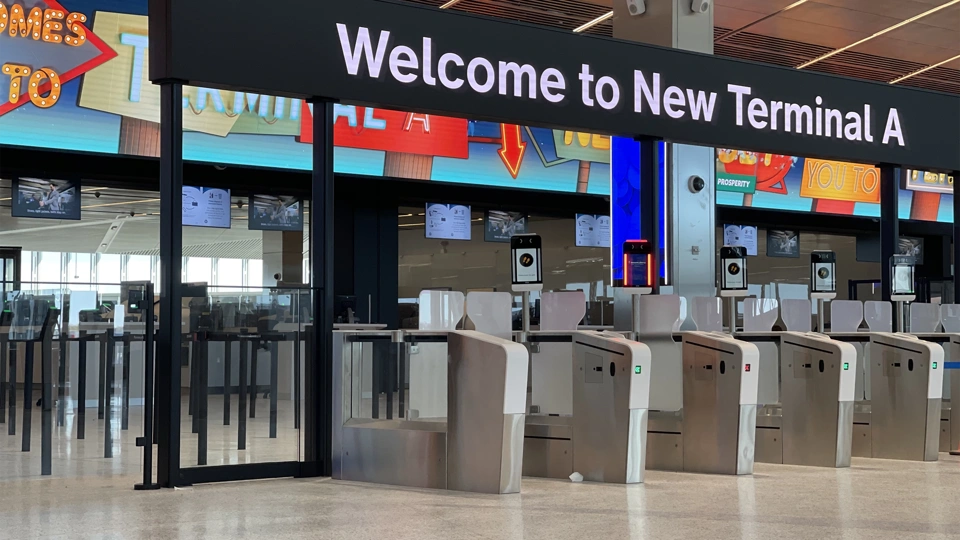
A. When we were approached to do Newark Liberty International Airport’s new $2.7bn Terminal A, we were behind the eight ball. The 1m square foot facility represents the single-largest investment in PANYNJ’s history, and we had a problem: we didn’t have a strong pipeline of MWBE firms on board.
What did we do? We went to work, and we did it the old-fashioned way. We started cold-calling anyone doing any type of work needed for the terminal. We started with some 2,100 firms and, in the end, identified fewer than 100 that were able to work at the required level.
We did, however, achieve significant MWSDBE participation—close to $1b worth of contracts.
A. The Port Authority has been actively engaged in growing DE&I for a quarter of a century now. Of course, after the death of George Floyd in Minnesota in 2020, there was an increased focus by many companies on what we all needed to do better.
First, we had internal conversations, holding 2,400 interviews asking employees how they felt about our DE&I policies and what they felt we could be doing more as a company.
We also created an MWSDBE task force. This is where our Executive Director and department Directors meet monthly to identify challenges and work to resolve them.
We have been running this for three years and have addressed many issues that were seen as barriers, such as the language used in RFPs and prompt payment, which can be a huge challenge for small firms.
Another success has been our community outreach centers. A lot of our facilities are in minority communities. While we are immensely proud of the economic engine that our facilities represent—airports, tunnels, and bridges—we understand the impact these have on local people.
Outreach centers make sure we keep our eye on the ball, so local communities share in the benefits—not only economically, but also socially—as we hear their views about what a facility should look like.
A. There is a saying in our community: “lift as we climb.”
To me, this means we can all learn from each other and must be open and available to have direct conversations about DE&I—helping each other improve practices as we go.
Sign up for our newsletter - trends, market intelligence and expert perspectives.
Sign up for our newsletter - trends, market intelligence and expert perspectives.